Showing posts with label pentatonic extended box. Show all posts

Saturday, 30 November 2013

Confession #45 - Pentatonic Scales (Part 4)


In Confession #43 - Pentatonic Scales (Part 2) we looked at Pentatonic Pattern #3.  In this week's confession, we'll look at Pentatonic Pattern #4.

We'll also explore how you can link up Pattern #1 and Pattern #4 when playing a I-IV-V chord progression.  There's a video demo and a TAB for this below.

See Confession #14 - Know What Chords to Play! and Confession #15 - Find the I, IV, V in any Key!  if you're not sure what a I-IV-V chord progression is or what the roman numerals mean.


Major Pentatonic Pattern #4

Here is major pentatonic pattern #4 in the key of C.  I've coloured the root notes red for easy reference.  I've also shown pattern #3 in the diagram so you can see how the two patterns are connected.  The dashed notes on the left belong only to pattern #3.  The notes in the middle are common to both patterns. The notes on the right belong only to pattern #4.


Minor Pentatonic Pattern #4

Here is minor pentatonic pattern #4 in the key of A minor.  Again, I've coloured the root notes red for easy reference and I've also shown pattern #3 in the diagram so you can see how the two patterns are connected.


Linking Pattern #1 and Pattern #4

Let's start this segment with the video demo and the TAB.  Below that we'll discuss where the notes are coming from and how the two patterns are connected in this demo.


Linking Pattern #1 and Pattern #4
(Click to Enlarge)

I started noodling around one day with the Am pentatonic scale.  All the while I was thinking that I would be playing whatever I came up with over an A major chord.

Why did I want to play the Am pentatonic scale over an A major chord?  Theoretically it shouldn't work.  An A major chord has a C# in it.  The A minor scale has a C in it.  The two should clash.  And they do, but in a way that sounds good.  Playing a minor pentatonic scale over a major chord is the sound of the blues and of rock and roll.

I was further thinking that this might be played over a 12 bar blues which, as we learned in Confession #41 - 12 Bar Blues!, uses the I, IV and V chords.  In the key of A, the chords would be A, D and E.

So, the lick starts with the Am pentatonic pattern #1 extended box for the first two measures, and would be played over an A major chord.

Then I was thinking what if the chord changed to D major?  I wanted to replicate the lick in the first measure, but play it in the key of D.  i.e. the lick would follow the chord (see Confession #41 - 12 Bar Blues! for another example of this) as it does in the third measure of the tab..

One way of doing this would be to simply play the lick 5 frets higher. That would transpose it to the key of D.

However, I wondered if I could find the lick closer by if I switched to a D minor pentatonic pattern.  That's when I had an epiphany:
  • The only difference between A minor pentatonic and D minor pentatonic is that A minor has an E note, and D minor has an F note.
  • Dm pentatonic pattern #4 is right under Am pentatonic pattern #1

This is illustrated in the chart below.


The chart also shows the location of the "blue note" or the "flat five" when using Am pentatonic pattern #1.  Here, the blue note is Eb,  and is used in the 2nd, 6th and 7th measures in the TAB above.

The other thing to note is that if you play pattern 4 at the 7th fret, then it would be Em pentatonic.  Thus, if you were playing over a 12 bar blues and wanted to follow the chords, you could:
  • play pattern #1 at the 5th fret for the I chord (A major),
  • play pattern #4 at the 5th fret for the IV chord (D major), and
  • play pattern #4 at the 7th fret for the V chord (E major).
To be clear, you could just play Am pentatonic over all three chords.  But knowing that you can follow the chord by switching to Dm pentatonic and Em pentatonic gives you another option for coming up with some great licks!


Next Week's Confession - Pentatonic Scales (Part 5)


Saturday, 16 November 2013

Confession #43 - Pentatonic Scales (Part 2)


In Confession #40 - Pentatonic Scales (Part 1) we looked at Pentatonic Pattern #1.  In this week's confession, we'll look at Pentatonic Pattern #2.


Major Pentatonic Pattern #2

Here is major pentatonic pattern #2 in the key of C.  I've coloured the root notes red for easy reference.  I've also shown pattern #1 in the diagram so you can see how the two patterns are connected.  The dashed notes on the left belong only to pattern #1.  The notes in the middle are common to both patterns. The notes on the right belong only to pattern #2.


Minor Pentatonic Pattern #2

Here is minor pentatonic pattern #2 in the key of A minor.  Again, I've coloured the root notes red for easy reference and I've also shown pattern #1 in the diagram so you can see how the two patterns are connected.

In Confession #35 - Repeat & Vary! (Improvisation 1) and Confession #40 - Pentatonic Scales (Part 1)  I talked about the pentatonic extended box.  Now you can see how those notes come from minor pentatonic pattern #2.  They are often used in conjunction with minor pentatonic pattern #1 as demonstrated in the TAB and video below.


I've also coloured two notes in blue.  I find that these two notes from the extended box are very powerful when played together.  You'll see/hear this in the TAB/video below.

I was trying to figure out why they are so powerful and here's what I came up with.  The E is the 5th in the key of A or Am.  We already know how powerful the 5th is from playing root-5 power chords.

The G is the flat 7th in the key of A or Am.  As discussed in last week's confession, the G is what turns an Am chord into an Am7 chord. It's also what turns a an A chord into an A7 chord.

Combined, the 5th and the flat 7th imply a minor 7th chord or a dominant 7th chord.  I suspect that is why they sound so good together.

See Confession #42 - 7th Chords Cheat Sheet! for more information on 7th chords.


VIDEO AND TAB

Here is a little riff that moves between the extended box from pattern #2 and pattern #1.  In the last measure, execute a grace note slide into the E at the 9th fret of the third string and hold it while you play the G at the 8th fret of the second string.


Next Week's Confession - Pentatonic Scales (Part 3)


Saturday, 21 September 2013

Confession #35 - Repeat & Vary! (Improvisation 1)


When I was doing lessons, my teacher would sometimes say "Let's Jam!" and start playing some rhythm guitar and let me lay down some lead lines.  Frankly, this terrified me.  My teacher was super-cool, but I always felt some self-imposed pressure to fill the space and to create some interesting lead lines.  Filling the space was easy.  Creating interesting lines, not so much.  So this usually resulted in me wandering up and down a pentatonic or major scale in a steady stream of eight notes.  Really boring stuff !!!


IMPROVISATION

True improvisation is the spontaneous creation of music, which sounds like a very wide-open mandate and thus makes improvisation very intimidating.  There are simply so many choices you can make that it is easy to become paralyzed.  However, there are a variety of techniques that you can use to make the task less daunting and the resulting music more interesting.

Most of us are never going to find ourselves on stage having to improvise a solo.  We'll be much more likely to apply these techniques in one of two situations:
  • we're jamming with our friends and thus are free to experiment, or
  • we're on our own and trying to come up with some riffs or licks, or a solo

REPEAT AND VARY

The first improvisation technique we'll cover is what I call "repeat and vary".  Your noodling around and have come up with something interesting.  Play it again and change it slightly!  Add a note, or drop one.  Play two 16th notes in place of one 8th note!  There are lots of options!


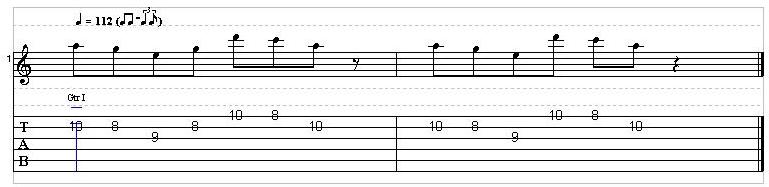
Am Pentatonic Lick #1

Here's an example of this technique.  The first measure below defines a musical phrase.  The second measure repeats the phrase but omits the G on the "and" of beat 2.  This results in two changes:
  • the stream of notes changes, and
  • the phrase finishes on the "and" of beat 3 instead of on beat 4

Am Pentatonic Lick #1
(Click to Enlarge)

Note the tempo indicator.  It's telling you to play with a shuffle rhythm.  If you aren't sure what a shuffle rhythm is, think of a typical blues tune.  The bass sounds something like this:

    Bump ba Bump ba Bump ba Bump
    1    &  2    &  3    &  4

Although its counted as an 8th note rhythm, the first 8th note is held a bit longer, and the second is shortened.


Am Pentatonic Extended Box

In case you are wondering, the notes in Am Pentatonic Lick #1 are taken from the Am pentatonic extended box, as shown below:

Am Pentatonic Scale with Extended Box
(Click to Enlarge)

Video


Ultimate Yoga Gear Giveaway from Gaiam


Next Week's Confession - Pull, Hammer and Slide! (Phrasing 1)