Showing posts with label dominant 7th chord. Show all posts

Saturday, 9 November 2013

Confession #42 - 7th Chords Cheat Sheet!


At some point in the future, I'll do a lesson on harmonizing the major scale in 7ths (see Confession #14 - Know What Chords to Play! for a lesson on harmonizing the major scale), but for now I'll provide a cheat sheet that will get you started quickly on 7th chords.

There are three 7th chords that you will commonly encounter.  The three chords are:
  • the major 7th chord,
  • the dominant 7th chord, and
  • the minor 7th chord
Let's jump right in and demonstrate the first two chords as G chords and the last chord as an Am chord.  Then we'll see how 7th chords fit into a harmonized major scale.


G MAJOR to G MAJOR 7

I have shown the fifth string muted for the G chord to keep things simple.  Just let your 2nd finger gently touch the fifth string to mute it.


Notice how when switching from the G major chord to the G major 7th chord, we lower the G on the first string 1 fret.  So the cheat sheet lesson here is take an octave of the root note of the chord and lower it a half step to make a major 7th chord.


G MAJOR to G DOMINANT 7

TIP - A dominant 7th chord is usually written like this: G7.  No need to put the word dominant in there.


Notice how when switching from the G major chord to the G dominant 7th chord, we lower the G on the first string 2 frets. So the cheat sheet lesson here is take an octave of the root note of the chord and lower it a whole step to make a dominant 7th chord.


A MINOR to A MINOR 7


Notice how when switching from the A minor chord to the A minor 7th chord, we lower the A on the third string 2 frets. So the cheat sheet lesson here is take an octave of the root note of the chord and lower it a whole step to make a minor 7th chord.


HARMONIZING IN 7ths

Back in Confession #14 - Know What Chords to Play! we learned how to harmonize the major scale and how the formula:

    I - ii - iii - IV - V - vi - viio

tells us which chords work in a particular key.

I'm going to ignore the viichord in the 7th chord cheat sheet because, it would hurt my brain to figure out, its got a really weird name, and its used very infrequently.

So summarizing the formula above:
  • the I, IV and V chords are major chords, and
  • the ii, iii and vi chords are minor chords

When you harmonize in 7ths, the summary changes only slightly:
  • the I and IV chords are major 7th chords, 
  • the V chord is a dominant 7th chord, and
  • the ii, iii and vi chords are minor 7th chords

So the way I remember this is:

  • the I and IV chords are still major, but they are major 7th.  (just add the note that is one fret below the octave)
  • the ii, iii and vi chords are still minor, but they are minor 7th.  (just add the note that is two frets below the octave)
So all you need to remember is that the V is chord is a dominant 7th chord. And really, this is just the V chord with one added note (the note that is two frets below the octave).


Next Week's Confession - Pentatonic Scales! (Part 2)


Saturday, 2 November 2013

Confession #41 - 12 Bar Blues!


Participate for a chance to win a trip to see your favourite band in concert! by Keurig


Last week we learned pentatonic pattern #1 (see Confession #40 - Pentatonic Scales (Part 1)).  This week we'll put that pattern to use over a 12 bar blues chord progression.


12 BAR BLUES

The 12 bar blues is a standard chord progression used frequently in, yes you guessed it, blues music.  It is also frequently used in rock and roll.  As you may have already guessed, the progression is 12 bars long.  At the end of the 12 bars, the progression is repeated again and again throughout the song.

Basic 12 Bar Blues

At its most basic, the progression consists of the I, IV and V chords of whatever key you happen to be playing in, organized like this:

|  I   |  I   |  I   |  I   |
|  IV  |  IV  |  I   |  I   |
|  V   |  IV  |  I   |  V   |

See Confession #14 - Know What Chords to Play!  if you aren't sure what the roman numerals mean.


In the key of A, the I, IV and V chords are A, D and E, so the progression would be:

|  A   |  A   |  A   |  A   |
|  D   |  D   |  A   |  A   |
|  E   |  D   |  A   |  E   |


Dominant Sevenths

It is also very common for the 12 bar blues to be played using all dominant 7th chords like this:

|  I7  |  I7  |  I7  |  I7  |
|  IV7 |  IV7 |  I7  |  I7  |
|  V7  |  IV7 |  I7  |  V7  |


See Confession #13 - Learn More Barre Chords! for examples of some dominant 7th chord fingerings.

As we'll learn in a future confession about harmonizing the major scale in sevenths, technically you change key every time you change chords when you play a 12 bar blues this way.

Quick Change

Another common variation is to play the IV chord or the IV7 chord in the second measure, like this:

|  I7  |  IV7 |  I7  |  I7  |
|  IV7 |  IV7 |  I7  |  I7  |
|  V7  |  IV7 |  I7  |  V7  |

This is referred to as the "quick change".  You'll hear the quick change in the Blue Brothers version of Sweet Home Chicago.


MOVEABLE RIFF

The first two measures of the TAB below introduce a riff that is played in 5th position and is based (mostly) on the A minor pentatonic scale.

The riff also includes the "flat-five" or the "blue note" (6th fret of your fifth string) which is not technically part of the scale, but is often used with it.  I'll talk more about the blue note in a future confession.

When the chord changes to a D in the 5th measure, the riff follows the chord.  The riff is identical except that it now it starts on a D instead of an A.

This could be done by staying on the fourth and fifth strings and moving up to 10th position, but its easier to shift to the third and fourth strings.  When a riff follows the chords like this, it is called a moveable riff.


VIDEO AND TAB

Here's a video demonstration of a 12 bar blues in the key of A using the moveable riff in the TAB below:


Here's the TAB for the song.  In the third and fourth measures I have shown the suggested fingerings for playing the riff.  I have also shown suggested fingering in the twelfth measure.  This is what works for me.  If it doesn't work for you then try a different fingering.


12 Bar Blues in the Key of A
(Click to Enlarge)

Have fun playing this one!


Next Week's Confession - 7th Chord Cheat Sheet!


Saturday, 13 April 2013

Confession #13 - Learn More Barre Chords!

In Confession #11 - Learn Root 6 Barre Chords and in Confession # 12 - Learn Root 5 Barre Chords we learned how to take the open E chord shape and the open A chord shape and use them to create a bunch more chords by sliding the shape up and down the neck of the guitar and barring finger 1 across all the strings.

In this week's confession, we'll learn how to create major, dominant 7th, minor and minor 7th barre chords.

With these extra chords, you'll have the ability to play the majority of the principal chords in any given key!

With this ability and a bit of knowledge from next week's confession, you'll have the ability to start creating your own chord progressions and write your own songs!

TRIVIA - The rhythm guitar part for The Cure's "Boys Don't Cry" consists entirely of root 5 barre chords, both major and minor.  Great songs can be written with just basic chords!


WARNING!  Barre chords can be very hard on your fretting hand.  Make sure that you warm-up first (see Confession #6 - Warm-Up!).  If you start to feel any pain or discomfort in your fretting had, stop immediately!  If you keep on playing, you can do serious damage to your fretting hand.


ROOT 6 / E SHAPE BARRE  CHORD VARIATIONS

First we'll start with some E shape major chords.

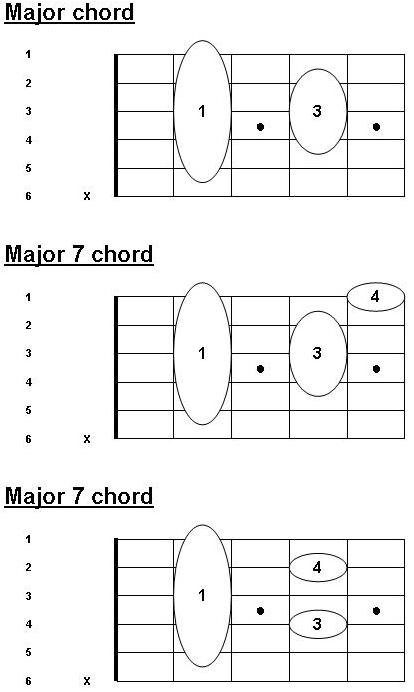
Remember from Confession #11 - Learn Root 6 Barre Chords!  that the name of the chord comes from the fretted note on the sixth string.  In the examples that follow, that's an F, so these are all variations on an F chord.


EDIT - The last 2 charts are labelled incorrectly, and should say Dominant 7th chord.  I will fix them later.

Note the two different ways of playing the dominant 7th chord.  While technically the same chord, each has a  slightly different feel, so try both and see which fits best in your song.


Next we'll do some E shape minor chords:


ROOT 5 / A SHAPE BARRE  CHORD VARIATIONS

First we'll start with some A shape major chords.

Remember from Confession #12 - Learn Root 5 Barre Chords!  that the name of the chord comes from the fretted note on the fifth string.  In the examples that follow, that's a B, so these are all variations on a B chord.


EDIT - The last 2 charts are labelled incorrectly, and should say Dominant 7th chord.  I will fix them later.

Next we'll do some A shape minor chords:


Spend some time practicing these chords to prepare for next week's confession.  Focus on the major and the minor chords, and if you have time the 7th chords.


Next Week's Confession - Know What Chords to Play!